Decimal Hours to Minutes Chart and Conversion Guide
· 6 min read
A decimal hours to minutes chart lets you look up common values without repeating the calculation. Multiply decimal hours by 60 to get total minutes. The tables below use different increments so you can choose the chart that matches the precision of the source value.
Download the printable decimal hours to minutes chart, or use the decimal hour to minutes converter for values that are not listed.
Decimal hours to minutes formula
minutes = decimal hours × 60
For example, 2.35 hours × 60 = 141 minutes, which is 2 hours 21 minutes. The digits after the decimal point are a fraction of an hour, not a minute field: 2.35 hours does not mean 2 hours 35 minutes.
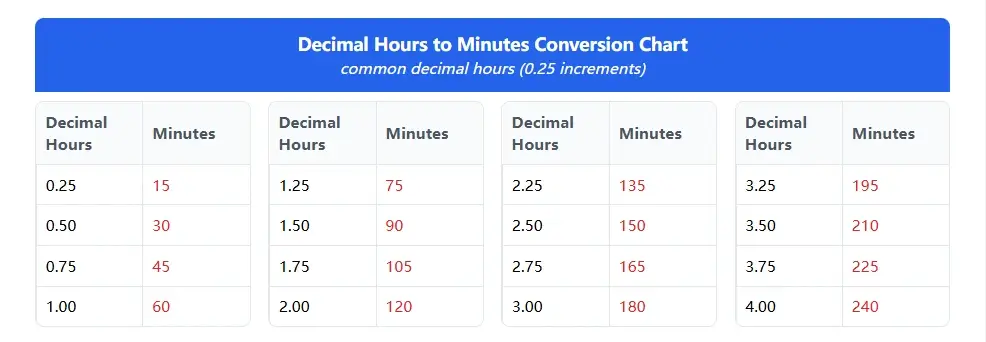
Quarter-hour decimal hours to minutes chart
The 0.25-hour chart is useful when the source values are already grouped into quarter-hour steps. It shows 0.25 = 15 minutes, 0.50 = 30 minutes, 0.75 = 45 minutes, and 1.00 = 60 minutes. It does not establish that quarter-hour rounding should be used for payroll or billing.
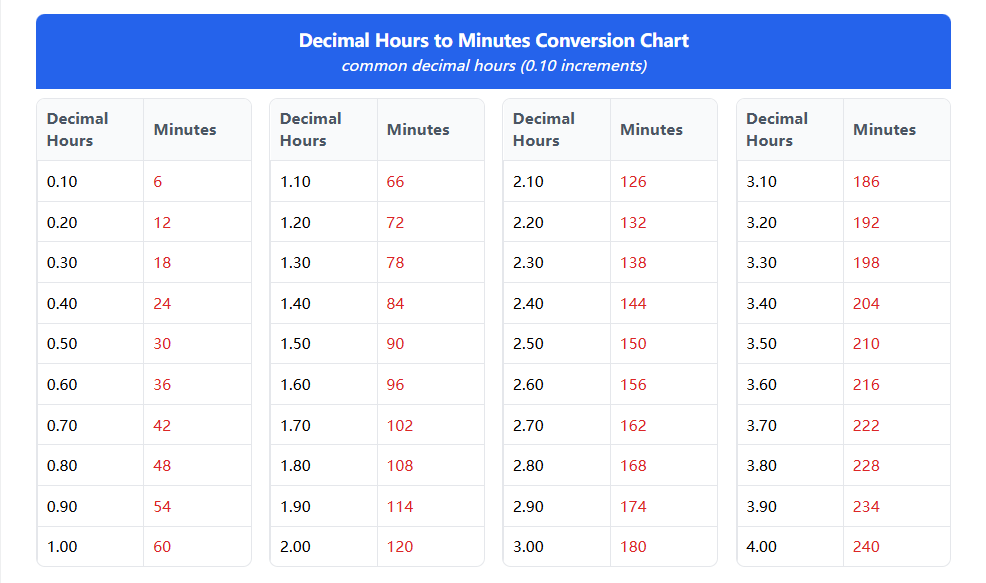
Tenth-hour chart
Each 0.1 hour equals 6 minutes, so 0.1, 0.2, and 0.3 hours equal 6, 12, and 18 minutes. A tenth-hour value can be exact when the original duration is a multiple of six minutes. Other durations must be rounded to fit this step.
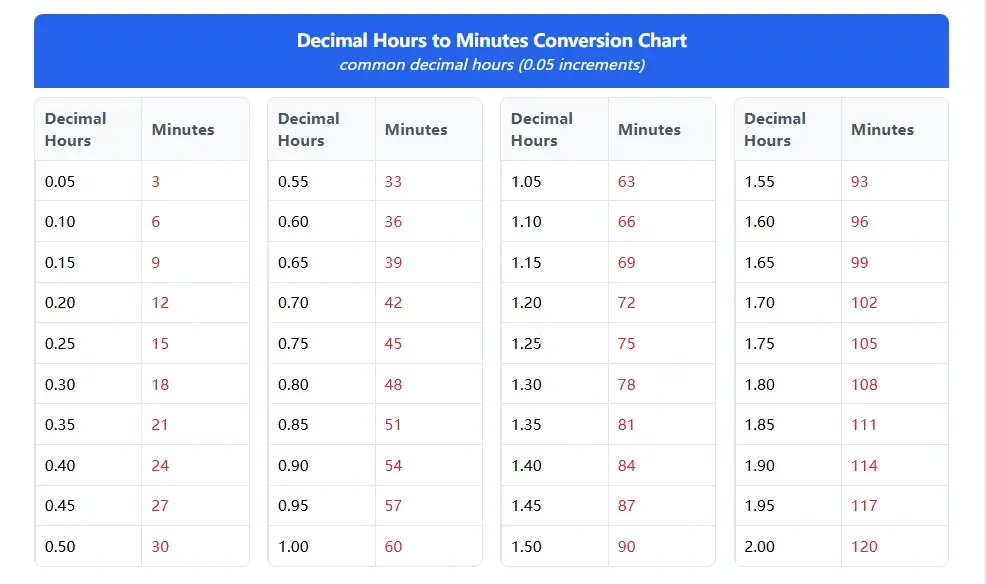
0.05-hour chart
An increment of 0.05 hour equals exactly 3 minutes. This chart is a compact reference for durations that use three-minute steps. More decimal places do not repair an imprecise source value; retain the original time entry when an exact audit trail matters.
Fractional minutes and rounding
A decimal hour can produce a fractional minute. For 1.234 hours, multiplication gives 74.04 minutes. Keep 74.04 minutes if the receiving system accepts hundredths of a minute. To display minutes and seconds, keep 74 whole minutes and multiply 0.04 × 60 = 2.4 seconds.
State where rounding occurs. Rounding the input hour first and then multiplying can differ from multiplying the original value and rounding the final result. For repeated calculations, choose one documented method and use it consistently.
Common mistakes when using the chart
- Reading decimal digits as minutes: 1.25 hours is 75 minutes, not 1 hour 25 minutes.
- Using a chart with the wrong step: a 0.25 chart cannot show 0.10-hour increments.
- Rounding twice: avoid rounding the input and the result unless the procedure requires both.
- Confusing duration with time of day: 2.5 hours is a length of time; 2:30 can also be a clock reading.
- Assuming a workplace rule: the chart performs conversion only and does not decide payable time.
Reverse conversion
To convert minutes back to decimal hours, divide by 60. For example, 135 ÷ 60 = 2.25 hours. See the minutes to decimal hours chart for the inverse lookup and its rounding examples.
Use the chart as a lookup, not as a rounding policy
A decimal hours to minutes chart answers a unit-conversion question: it does not decide which recorded time should be rounded. If an input falls between listed increments, multiply the original decimal by 60 instead of choosing the visually nearest row. For example, 0.18 hour equals 10.8 minutes; neither the 0.15 nor 0.20 row is an exact substitute. Preserve 10.8 minutes or convert the fractional 0.8 minute to 48 seconds before applying a separately documented display or business rule. When several people use the same worksheet, label the chosen chart increment beside the result so another reader can reproduce the lookup.