Minutes to Decimal Hours Chart and Rounding Guide
· 6 min read
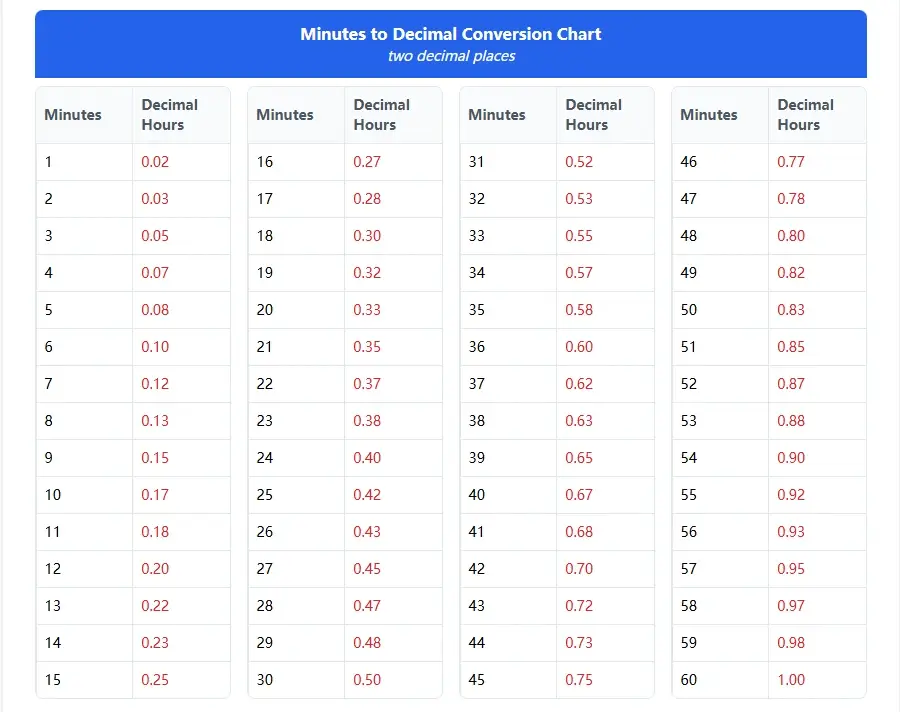
A minutes to decimal hours chart shows the result of dividing minutes by 60. The same source minute can display differently at two, three, or four decimal places, so choose the precision required by the receiving worksheet or system and record the rounding rule.
A printable minutes to decimal hours chart is available for offline lookup. Use the minutes to decimal hour converter when you need a value outside the chart.
Minutes to decimal hours formula
decimal hours = minutes ÷ 60
For 42 minutes, 42 ÷ 60 = 0.70 hours. For 20 minutes, 20 ÷ 60 = 0.3333… hours, so a display limited to two decimal places shows 0.33 while a three-place display shows 0.333. The repeating value explains why the selected precision matters.
Two-decimal minutes to decimal hours chart
Two places are compact and often sufficient for estimates. One hundredth of an hour equals 0.6 minute, or 36 seconds, so a two-place value cannot represent every whole minute exactly. For example, 8 minutes becomes 0.13 hours at two places.
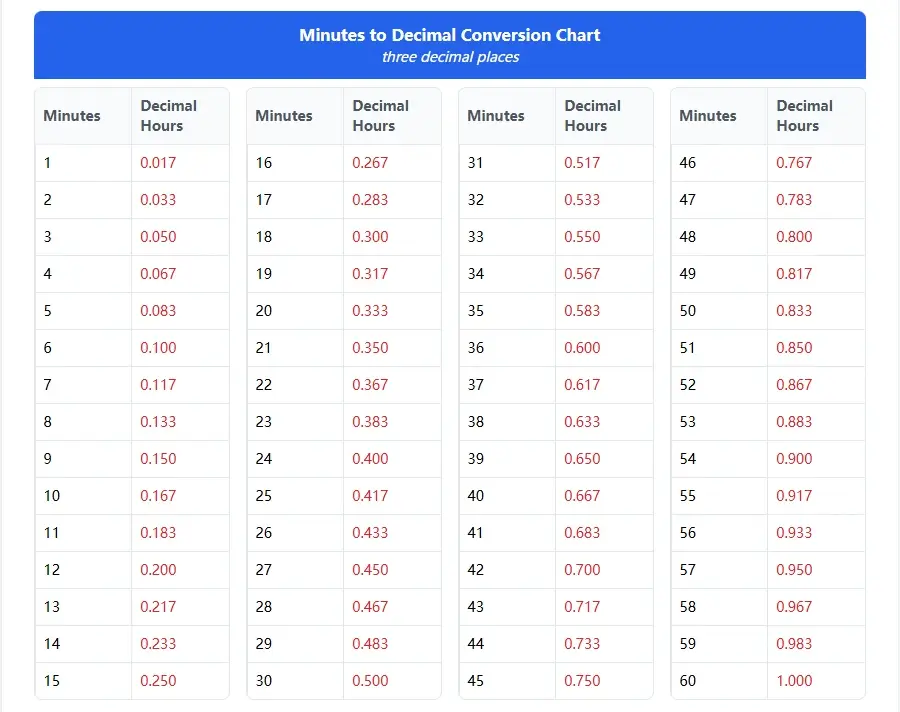
Three-decimal chart
Three decimal places preserve more of a repeating fraction. One thousandth of an hour equals 3.6 seconds. This can be useful when a downstream calculation is sensitive to small differences, but the extra digit should not imply that the original record was measured to that precision.
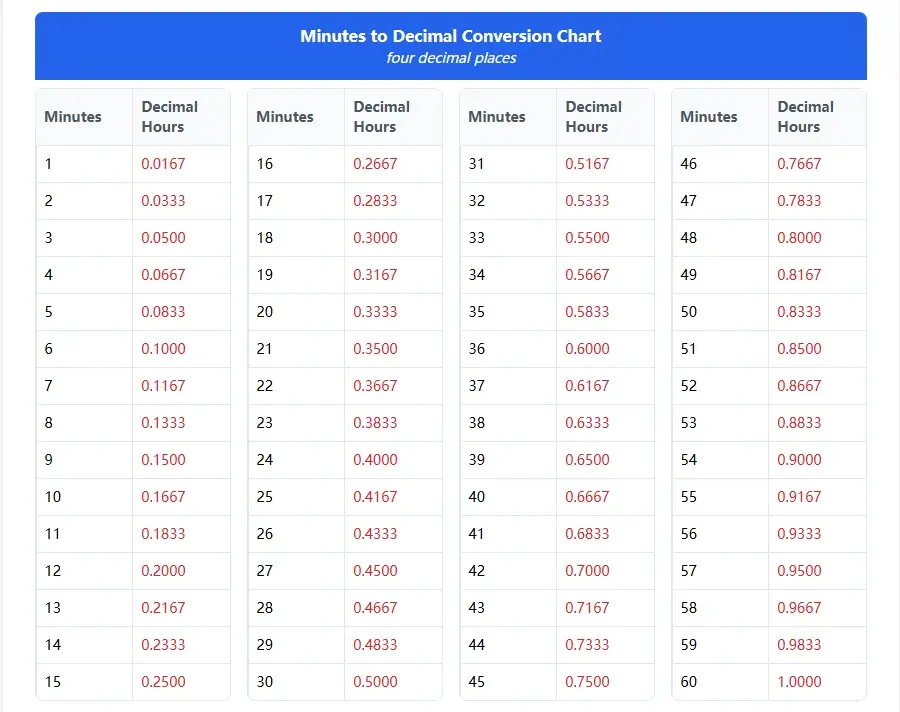
Four-decimal chart
Four decimal places reduce displayed rounding loss further: 0.0001 hour equals 0.36 second. Use four places only when the source and receiving process justify them. A whole-minute input does not become a sub-second measurement merely because more digits are printed.
Worked examples
- 15 minutes ÷ 60 = 0.25 hours exactly.
- 37 minutes ÷ 60 = 0.61666… hours, displayed as 0.62, 0.617, or 0.6167.
- 90 minutes ÷ 60 = 1.50 hours. Values over 60 minutes are valid durations.
- 135 minutes ÷ 60 = 2.25 hours.
How rounding affects totals
Converting and rounding each row before adding can produce a different total from adding all source minutes and converting once. For example, three entries of 20 minutes each become 0.33 + 0.33 + 0.33 = 0.99 hour at two places, while 60 total minutes converts to 1.00 hour. Decide which method the receiving process expects and document it.
For payroll, billing, or contractual records, the chart only supplies arithmetic. It does not decide which minutes are payable, whether entries may be rounded, or which precision a jurisdiction or organization requires.
Common chart-reading mistakes
- Writing 45 minutes as 0.45. The correct value is 45 ÷ 60 = 0.75 hours.
- Mixing precisions in one column. Use a consistent number of places or retain the unrounded values.
- Adding a rounded column without checking source minutes. Row-level rounding can accumulate.
- Calling decimal hours a clock time. 7.50 hours is a duration, not necessarily 7:50 on a clock.
Convert decimal hours back to minutes
Multiply decimal hours by 60 for the reverse operation. A value of 1.75 hours × 60 equals 105 minutes. The decimal hours to minutes chart provides quarter-hour, tenth-hour, and 0.05-hour reference steps.
Choose chart precision from the next calculation
Two decimals are usually easier to scan, while three or four retain more of a repeating fraction. The right column depends on what happens next. If values will be multiplied by a rate or added across many rows, keep the unrounded fraction in the calculation and use the chart only for display. If a destination accepts a fixed number of decimals, select that column deliberately and record that precision so another person can reproduce the same minutes-to-decimal-hours result.