Time Clock Rounding Guide: Increments and Examples
Time clock rounding changes an entered clock time to a selected interval. This guide shows the arithmetic for 5-, 6-, 10-, 15-, and 30-minute increments. It does not determine whether rounding is permitted for a particular worker or location.
What Is Time Clock Rounding?
Time clock rounding is the process of adjusting an employee’s actual clock-in or clock-out time to the nearest predefined interval — such as 5, 6, 10, 15, or 30 minutes. This method simplifies time calculations and standardizes how worked hours are recorded.
For example: - If an employee clocks in at 7:53 AM and the rounding increment is 15 minutes, the time may be rounded to 8:00 AM. - If they clock out at 4:07 PM, it might round to 4:00 PM, depending on the chosen rounding direction.
Why Businesses Use Time Clock Rounding
- It simplifies payroll data processing.
- It reduces the complexity of managing manual or legacy timekeeping systems.
- It ensures consistency across departments or shifts.
- It provides clear and standardized reporting for total work hours.
Common Time Clock Rounding Increments
Different systems may offer different intervals. The examples below are calculation options, not recommended policies:
| Rounding Increment | Equivalent in Minutes | Typical Use Case |
|---|---|---|
| 0.1 hour | 6 minutes | Common for decimal-based payroll systems |
| 5 minutes | 5 minutes | Retail or small office environments |
| 10 minutes | 10 minutes | Simpler hourly tracking |
| 15 minutes | 15 minutes | Traditional “quarter-hour” rounding |
| 30 minutes | 30 minutes | Simplified for longer shifts |
When using the Time Clock Rounding Calculator, you can test how each interval affects total paid time, ensuring your chosen increment makes sense for your workflow.
Understanding Rounding Directions
Time rounding doesn’t only depend on the increment — it also depends on direction. Choosing the correct rounding direction determines whether times are adjusted up, down, or to the nearest increment.
| Rounding Direction | Description | Example (with 15-minute increment) |
|---|---|---|
| Nearest | Rounds to the nearest 15 minutes. | 8:07 → 8:00 / 8:08 → 8:15 |
| Always Up | Always rounds up to the next increment. | 8:01 → 8:15 |
| Always Down | Always rounds down to the previous increment. | 8:14 → 8:00 |
The nearest direction chooses the closest increment. That describes the math only; actual effects should be tested against source records instead of assuming the result is neutral or fair.
The Importance of Neutral Rounding
Applying the same formula to clock-ins and clock-outs makes the arithmetic consistent, but it does not prove that the results are unbiased over a real set of records. Preserve the original punches and compare aggregate increases and decreases.
The Time Clock Rounding Calculator applies the selected increment and direction to one entered timestamp. It does not evaluate employment law or approve a policy.
Examples of Time Clock Rounding in Practice
Let’s visualize how time clock rounding works in different scenarios. The following table assumes a 15-minute rounding increment using the “nearest” rule:
| Actual Time | Rounded Time | Adjustment |
|---|---|---|
| 7:53 AM | 8:00 AM | +7 minutes |
| 8:08 AM | 8:15 AM | +7 minutes |
| 8:22 AM | 8:15 AM | -7 minutes |
| 8:37 AM | 8:30 AM | -7 minutes |
| 8:44 AM | 8:45 AM | +1 minute |
The table makes each adjustment visible. Review both the rounded value and the original entry whenever the result is used beyond a demonstration.
Visual Chart: Rounding to Nearest 15 Minutes
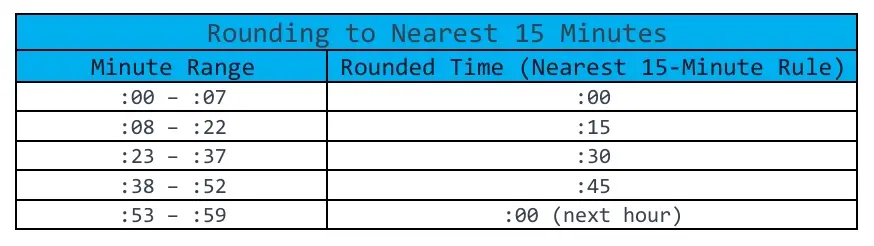
This chart is a simplified version of the one provided in the Time Clock Rounding Calculator, making it easy to visualize how times shift within an hour.
Conclusion
Time clock rounding can make grouped values easier to total, but it also changes the source data. Keep the unrounded entries, document the selected formula, and confirm the applicable employment, contract, and organizational requirements.
Use the Time Clock Rounding Calculator to inspect one timestamp or the Time Card Calculator to model a weekly total with user-selected settings.